Peace Pilgrimage 1 – written by our guide, Jamie Emmerson, with landscape/church photos by Sam
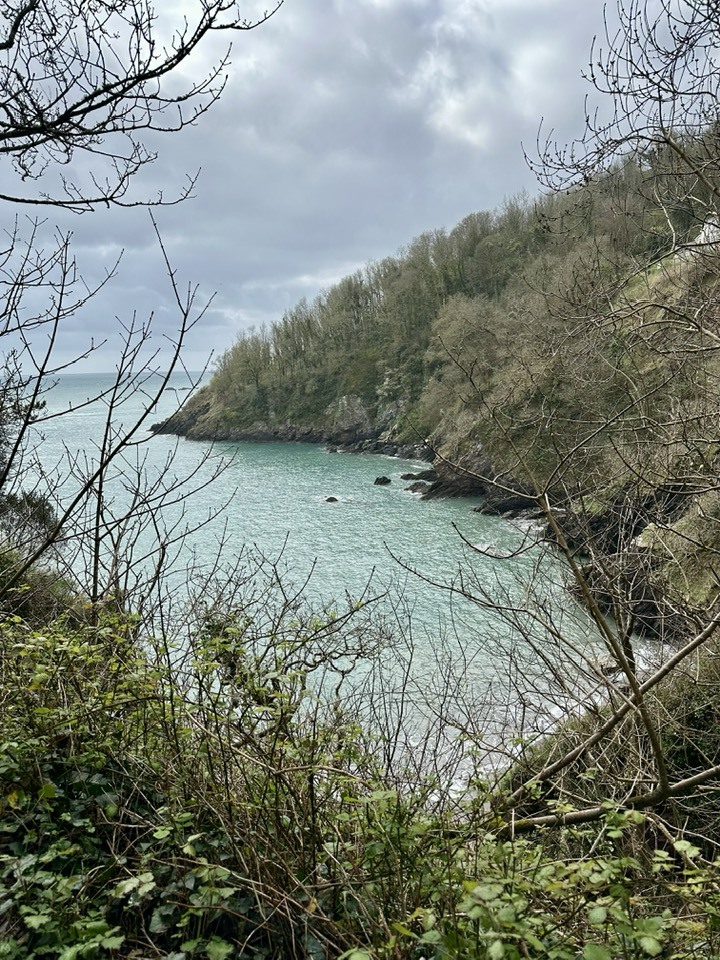
Starting at Sugary Cove, as shown here, the first River Dart Wild Church “sea to source” pilgrimage of 2026 wound its way up the headland and into Dartmouth, across the Dart itself, and back again. The theme for the walk was empire, not only as a historical phenomenon but as a way of being, shaped by relationships of extraction. Our pilgrimage coincided with Easter Saturday, a day of quiet reflection in the Christian tradition, lying between crucifixion and resurrection. This moment of transition, of liminality between states—one coming to an end, another yet to begin—seemed like a good time to turn our attention towards what Gloria Anzaldua called the “borderlands”. These are the places in between, where one thing becomes another thing. In some traditions, these borderlands are places of meeting and connection, where transformation becomes possible. Yet in contexts of empire, borders are often held to be absolute, no matter how arbitrary. These are not just national borders, but those that delineate race, class, gender, species, and even those that separate the living from the non-living. To begin to heal from empire requires bringing these separations—and the wounds they sustain—back into our awareness. So, as the spring tide receded enough to reveal the beach of Sugary Cove, we began with a meditation, guided by the question: where does a wave end?
Making our way back up the cliff path, Dartmouth came into view, watched over by Dartmouth Castle. The town’s history is often told through the lens of trade, conquest, and naval power, yet other, quieter histories are also present. Not far from the castle stands St Petrox Church, built above a spring that had likely been a site of reverence and pilgrimage long before the Norman structure was established. Entering the church, we held in mind not only those whose lives are commemorated in stone, but also those whose contributions and sacrifices remain unmarked. Among these, the Dart River salmon offered a particularly poignant presence. For millions of years, salmon have travelled thousands of miles across the North Atlantic before returning, with remarkable precision, to the river of their birth. Today, they are considered at risk, and what was once a source of abundance has become increasingly fragile. Their journey provided a quiet counterpoint to the outward movements that have so often defined Dartmouth’s human history.
Continuing along the river, we made our way towards Warfleet Creek, where we paused briefly to reflect on the condition of the Dart in the present day. Like many rivers today, it is subject to multiple pressures, including periodic sewage discharge. This led to a short reflection on what Max Liboiron has termed the “threshold theory of pollution”, in which harm is deemed acceptable below certain calculated limits. While these thresholds are grounded in scientific modelling, they also reflect particular assumptions about what counts as “violence”. All too often, those who bear the brunt of empire’s destruction are rendered “non-persons” to bypass issues of consent. As we approached Bayard’s Cove, we turned more directly to Dartmouth’s role within wider histories of empire. This was a place from which people departed in search of trade, opportunity, and, in some cases, new worlds. It can be tempting to interpret such histories in terms of individual moral character, yet it may also be helpful to consider the wider conditions from which these movements emerged. Early modern Europe was marked by profound upheaval, including plague, economic instability, persecution, famine, and war. What has been described as a form of collective or transgenerational trauma—”post-apocalypse stress syndrome”, in Lawrence Gross’ parlance—may have shaped not only the desire to leave, but also the ways in which new places and peoples were encountered. In this sense, what travelled outward from places like Dartmouth may have included not only ambition, but also unresolved wounds.
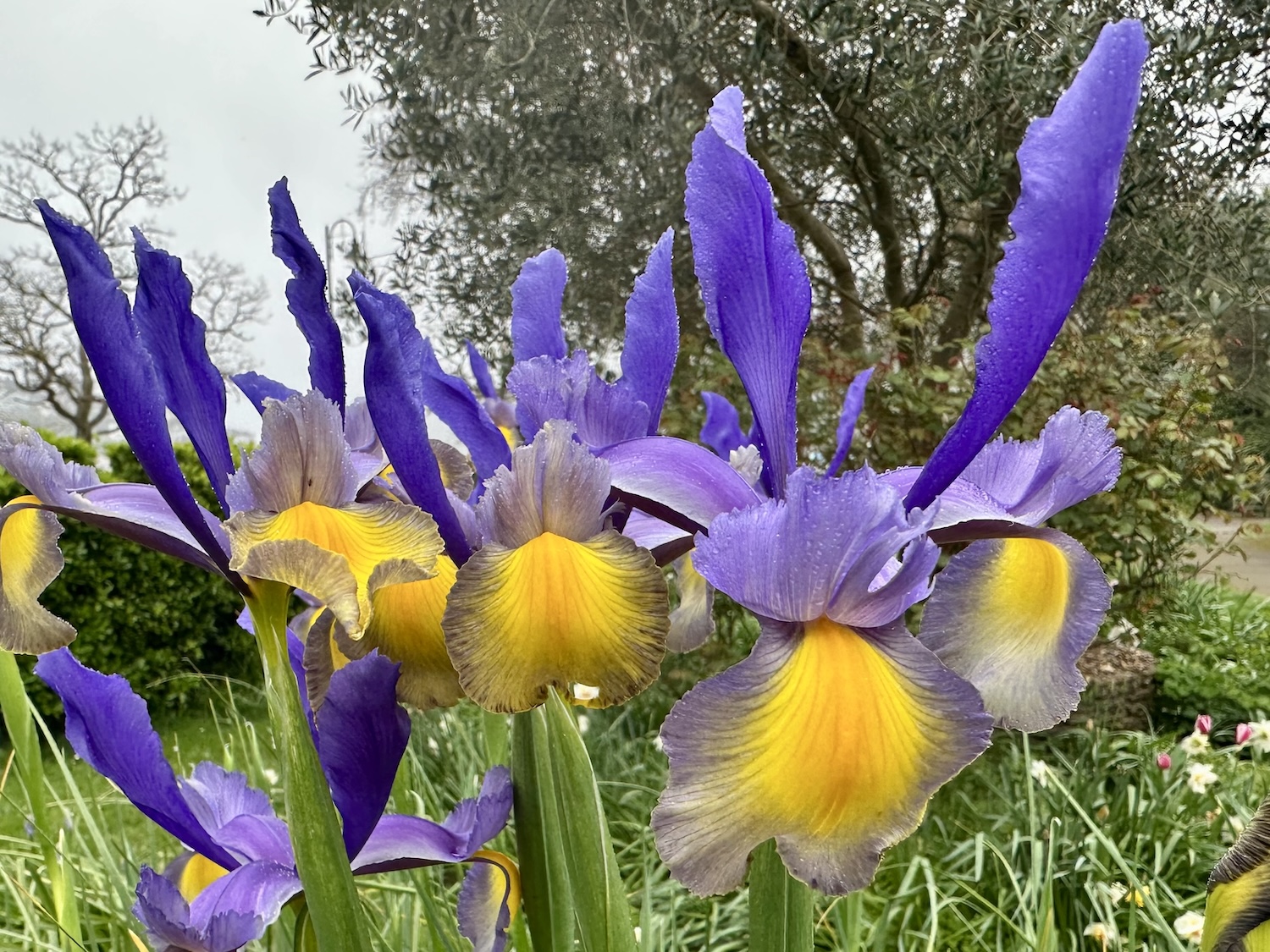
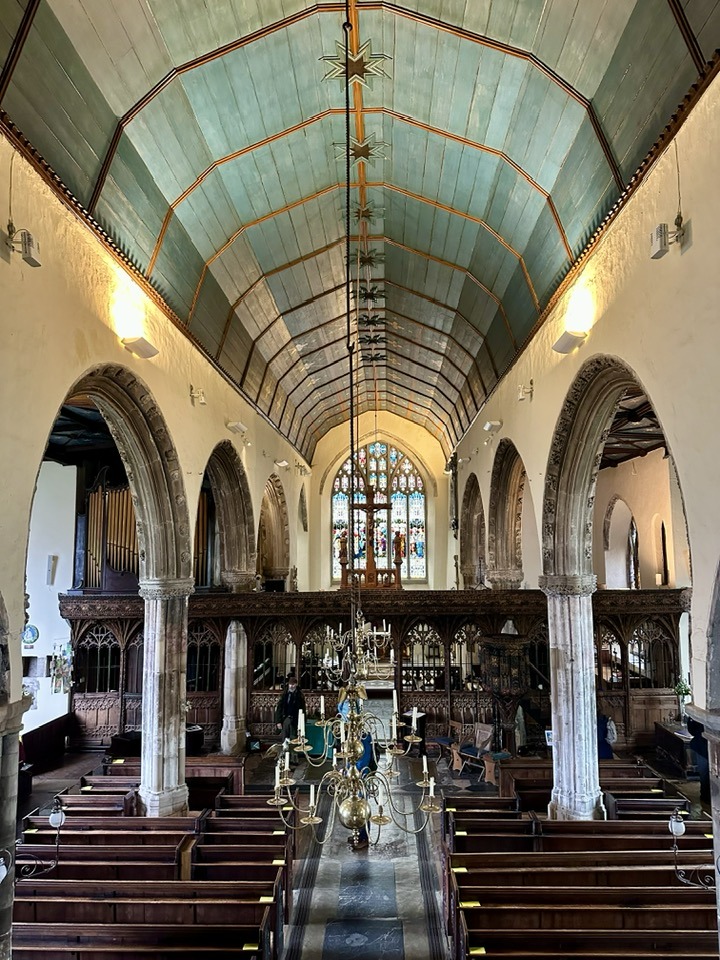
Crossing the ferry to Kingswear, the tone of the day shifted as we gathered for lunch, accompanied by a very sociable robin. We took a few moments to acknowledge the sustenance provided by the plants, whose lives make our own possible, before continuing in silence along the river. At the marina, a passing steam train prompted an unexpected moment of shared joy, as we found ourselves waving to the passengers, who responded in kind. By the time we reached the second ferry, the mist had turned to drizzle and hoods had come up, but the steady rhythm of walking continued. Our final pause took place amongst the spring flowers of a community garden, (including the beautiful iris shown above) where we reflected on grief not only as a response to loss, but as the possibility of deeper forms of love. This included an awareness of the many sacrifices that sustain our lives, often without recognition. With this in mind, we returned to Dartmouth and entered St Saviour’s Church, as shown here, where we took time to appreciate the intricacy of the rood screen, the beauty of the altar, and the worn threshold of the fourteenth-century door, marked by the Tree of Life. Sitting together, we shared some closing reflections before stepping back out into the town and heading off, somewhat unsuccessfully, in search of crab sandwiches (sorry again!).
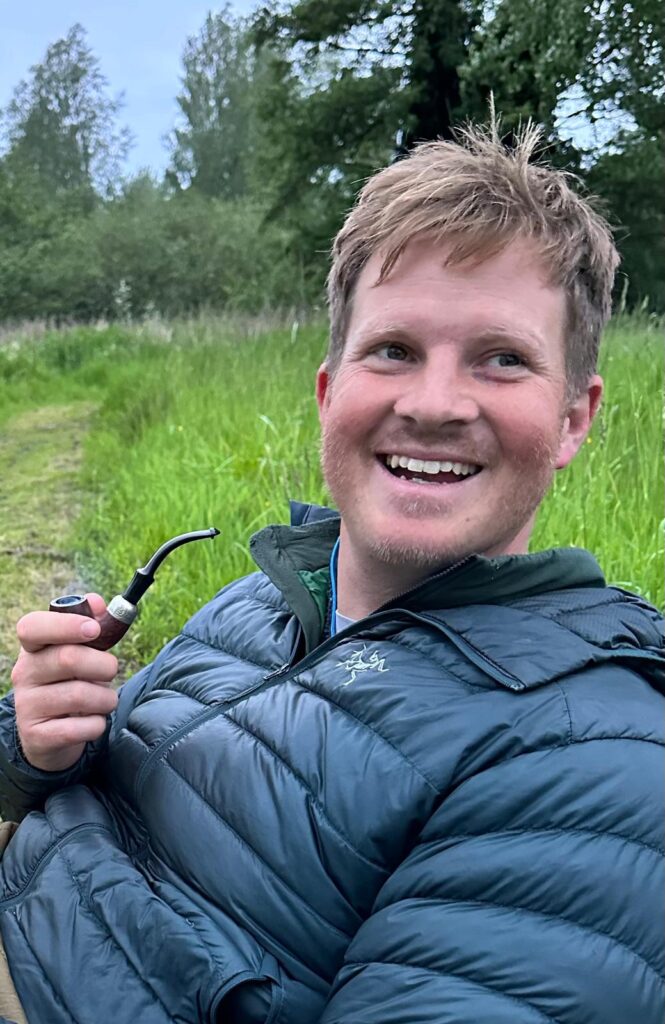
Jamie’s (as shown here with his great grandfather’s pipe) Reading list:
On the notion of acceptable harm, assimilative capacity, and the threshold theory of pollution (and why dumping our mess on others, then pretending they can’t / don’t mind, is a hallmark colonialism), see Max Liboiron’s Pollution is Colonialism.
On the links between industrialisation, plantations, empire, and military thinking, Anna Tsing’s The Mushroom at the end of the World is excellent.
Graeber and Wengrow’s Dawn of Everything discusses how responsibility and ownership were separated under Roman times (along with many other fascinating ideas).
On the mindset of coloniality, including the dangers of following the colonial impulse towards essentialist-individualist dichotomies innocence and blame, I would really recommend Vanessa Machado de Oliveira’s Hospicing Modernity.
On the subject of whether empire only happened “over there” (i.e. outside Europe), I would really recommend Imperial Mud by James Boyce. Boyce looks at the colonial expansion of the British Empire into a place that was largely uncolonized even during the Roman, Saxon, Viking, and Norman invasions, despite being barely 60 miles from London.
On the role that trauma can play in addiction—including “acceptable” addictions such as workaholism and consumerism—Gabor Maté’s In the Realm of the Hungry Ghosts and The Myth of Normal are excellent. Also, Bruce Alexander’s The Globalisation of Addiction is helpful too, as is Eduardo and Bonnie Duran’s Healing the American Indian Soul Wound.
For post-apocalypse stress syndrome, see the work of Lawrence Gross. He introduces the idea in his book, Anishinaabe Ways of Knowing and Being, building on Duran’s work.
For an accessible and fascinating look at how silly our culturally-engrained anthropocentrism is, as well as the limits of seeing the world through the lens of hard-coded binaries of absolute separation, see James Bridle’s Ways of Being.